
Understanding International Safety Signs and Symbols with GAK
Join GAK as we explore how to read and understand international safety signs and symbols. Together, we aim to help you clearly recognize workplace safety procedures and guidelines.
Although safety symbols may vary slightly from country to country, we hope this guide will help you understand their meanings and apply them effectively, contributing to a safer working environment at your own production facilities.
What Are Safety Signs and Safety Symbols?
Safety signs and symbols are graphic labels designed to alert people to potential hazards, required precautions, and necessary protective equipment in specific areas.
Their primary purpose is to prevent injuries and accidents that may occur due to hazardous equipment, materials, or locations where the signs are displayed.

Why Do Manufacturing Facilities and Workplaces Need Safety Signs?
According to ISO 3864-1:2011 standards on safety colors and signs, the GHS (Globally Harmonized System) provides standardized, easy-to-understand safety information recognized worldwide.
These signs enable workers to quickly identify hazards, understand risks, and comply with personal protective equipment (PPE) requirements—helping reduce workplace accidents and improve overall safety awareness.
Types of Safety Signs and Symbols
Standard safety signs are represented through graphics, icons, symbols, shapes, or brief text explanations. They follow international conventions so that people across different countries and cultures can easily understand their meaning.
Below are the four main categories of safety signs:
Prohibition Signs
Prohibition signs indicate actions that are not allowed. These signs are red, circular, and feature a diagonal slash from left to right at a 45-degree angle.
Their purpose is to prevent behaviors that could pose risks to individuals or groups in the area.
Examples: No Smoking, No Entry.
Warning Signs
Warning signs alert people to potential hazards in a specific area. They are typically triangular, with a yellow or amber background and black symbols or text.
These signs highlight dangers that may not be immediately obvious but require special attention.
Examples: Falling Objects, High Voltage, Slippery Surface.
Mandatory Signs
Mandatory signs indicate actions that must be followed. They are circular, with a blue background and white symbols.
Their purpose is to protect individuals from hazards that may arise if safety instructions are ignored. These signs are often used in restricted or high-risk areas where special precautions are required.
Examples: Wear Safety Helmet, Wear Protective Gloves.
Emergency Signs
Emergency signs are among the most familiar safety signs. They help people quickly locate emergency exits or first aid assistance during dangerous situations.
These signs are square or rectangular, with a green background and white symbols.
Examples: Emergency Exit, First Aid Station, Emergency Assembly Point.
Classification of GHS Symbols by Hazard Type
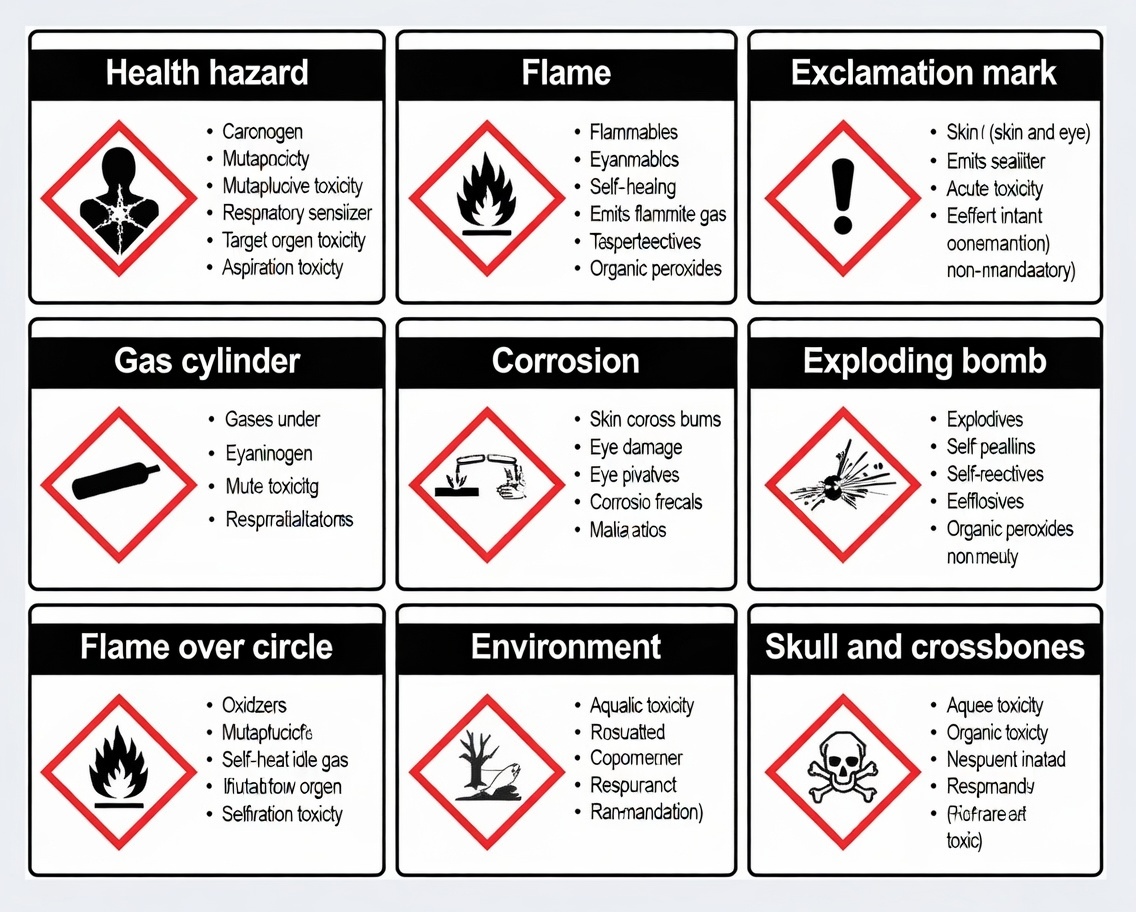
GHS symbols (Globally Harmonized System) are used to identify the level and type of chemical hazards in workplaces and industrial environments. Each symbol represents a specific risk related to human health, physical safety, or environmental protection.
Below are the most common GHS symbols under HCS standards, along with their meanings:
Health Hazard
Symbol showing a human silhouette with damage to the chest area.
Used for chemicals that may cause serious and long-term health effects, such as cancer, organ damage, or respiratory issues after prolonged exposure.
Flammable
Flame symbol.
Applies to flammable liquids, solids, or gases that can easily ignite when exposed to heat, sparks, or air.
Irritant / Harmful / Ozone Layer Hazard
Exclamation mark symbol.
Warns of chemicals that may cause skin, eye, or respiratory irritation, pose health risks, or contribute to ozone layer depletion.
Gas Under Pressure
Gas cylinder symbol.
Indicates gases stored under high pressure, which may explode when heated or cause cold burns if released in a liquefied state.
Corrosive
Symbol showing liquid corroding metal and skin.
Warns of chemicals that can cause severe skin burns, corrode metals, and damage living tissue upon contact.
Explosive
Exploding bomb symbol.
Used for chemicals that may explode violently, posing serious danger to people and surrounding structures.
Oxidizing
Flame over a circle symbol.
Represents substances that can cause or intensify fire, increasing the risk of combustion or explosion when in contact with other materials.
Environmental Hazard
Dead tree and fish symbol.
Indicates chemicals that may cause long-term environmental damage, particularly to aquatic ecosystems and soil.
Toxic
Skull and crossbones symbol.
Used for highly toxic substances that can cause severe injury or death even at very low exposure levels.
Above is a complete guide to understanding international safety signs and symbols. We hope this information helps improve your awareness of occupational safety and health.
If you are looking for personal protective equipment (PPE) or specialized protective workwear, please feel free to contact GAK. We are always ready to support you in building a safer workplace.